

how does one touch binary options work
Make your site work on bear on devices
Touchscreens on mobile phones, tablets and impact-enabled laptops and desktops open a whole new range of interactions for web developers. In this introduction, we'll expect at the basics of how to handle touch events in JavaScript. See the downloadable tutorial files for the supporting step-by-step example demos.
Do we demand to worry about touch?
With the ascension of touchscreens, one of the central questions from developers has been: what do I need to do to make sure my website or web application works on touch devices? Surprisingly, in most cases, the answer is: nothing at all. By default, mobile browsers are designed to cope with the large corporeality of existing websites that weren't adult specifically for affect. Not only practice these browsers work well with static pages, they too handle sites that provide dynamic interactivity through mouse-specific JavaScript, where scripts have been hooked into events like mouseover.
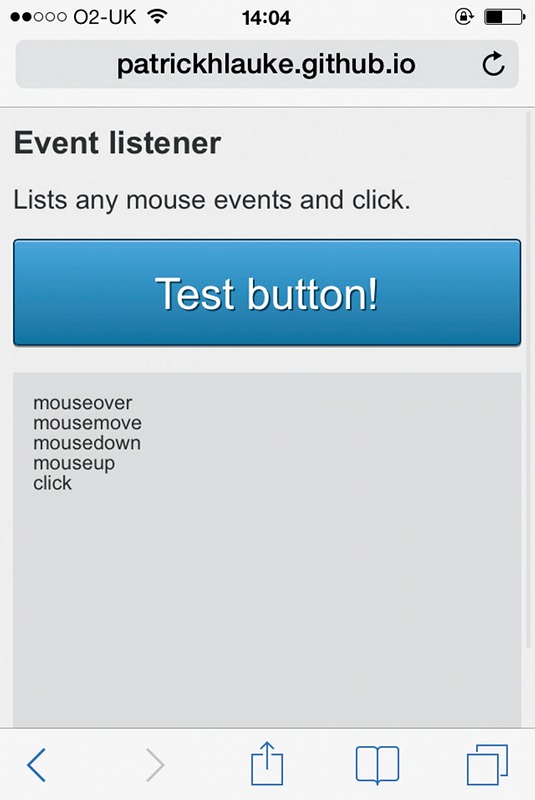
To this finish, browsers on touch-enabled devices trigger simulated, or constructed, mouse events. A simple test page (see example1.html in the tutorial files) shows that, even on a touch device, tapping a button fires the following sequence of events: mouseover > (a single) mousemove > mousedown > mouseup > click.
These events are triggered in rapid succession, with almost no filibuster between them. Too note the single 'sacrificial' mousemove event, which is included to ensure that any scripts that may be listening to mouse movement are also being executed at least once. If your website is currently prepare to react to mouse events, its functionality will (in virtually cases) notwithstanding work without requiring any modifications on bear upon devices.
Shortcomings of simulated mouse events
As skilful equally the fallback to simulated mouse events is, there are, however, withal situations where purely relying on mouse-specific scripts may upshot in a suboptimal feel.
Delayed click events
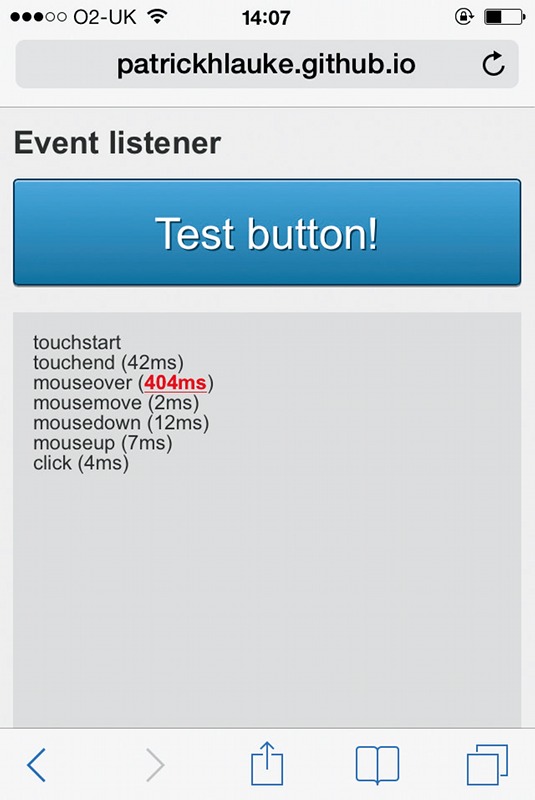
When using a touchscreen, browsers introduce an artificial delay (in the range of well-nigh 300ms) between a touch on action, such as borer a link or a button, and the time the actual click event is fired. This delay allows users to double-tap (for instance, to zoom in and out of a page) without accidentally activating any page elements (see example2.html). This delay tin exist a trouble if yous want to create a web application that feels snappy and native. For regular web pages, this is unlikely to be an issue every bit this is the default behaviour users understand from about sites.
Tracking finger movements
Equally we already saw, the synthetic mouse events dispatched by the browser also include a mousemove event. This will e'er exist just a single mousemove. In fact, if users motility their finger over the screen too much, constructed events will not be fired at all, as the browser interprets the movement as a gesture, such as scrolling. This is a trouble if your site relies on interactions involving mouse movements (such every bit drawing applications or HTML-based games), as just listening to mousemove won't work on bear on devices. To illustrate this, let's create a simple canvass-based application (see example3.html). Rather than the specific implementation, nosotros're interested in how the script is set to react to mousemove:
var posX, posY; ... function positionHandler(e) { posX = e.clientX; posY = due east.clientY; } ... canvas.addEventListener('mousemove', positionHandler, faux ); If you try out example 3 (in the tutorial files) with a mouse, you'll see that the position of the arrow is continuously tracked as you move over the sail On a touch device, you lot'll notice it won't react to finger movements; information technology only registers when a user taps on the screen, which will fire that single synthetic mousemove issue.
"Nosotros demand to get deeper…"
To work around these problems, we demand to get our hands muddied at a lower abstraction level. Affect events were start introduced in Safari for iOS 2.0, and, post-obit widespread adoption in (almost) all other browsers, were retrospectively standardised in the W3C Touch Events specification. The new events provided by the touch events model are: touchstart, touchmove, touchend and touchcancel. The starting time three are the touchspecific equivalent to the traditional mousedown, mousemove and mouseup events. On the other manus, touchcancel is fired when a touch interaction is interrupted or aborted. For instance, when a user moves their finger outside of the current certificate and into the bodily browser interface. Looking at the social club in which both touch and constructed mouse events are dispatched for a tap (see example4.html in the tutorial files), we go the following sequence: touchstart > [ touchmove ]+ > touchend > mouseover > (a single) mousemove > mousedown > mouseup > click.
First, we get all the bear on-specific events: touchstart, zero, or more touchmove (depending on how cleanly the user manages to tap without moving the finger during contact with the screen) and touchend. Later on that, the browser will fire the synthetic mouse events and the final click.
Feature detection for touch event support
To determine if a item browser supports touch events, we're able to use a simple bit of JavaScript feature detection:
if ('ontouchstart' in window) { /* browser with Touch Events support */ } This snippet works reliably in mod browsers. Older versions take a few quirks and inconsistencies that require y'all to jump through diverse dissimilar detection strategy hoops. If your application is targeting older browsers, try Modernizr (modernizr. com) and its various touch test approaches, which shine over virtually of these bug.
When conducting this sort of feature detection, we need to be clear what we're testing. The prior snippet simply checks for the browser'southward capability to understand impact events and shouldn't be used as a unproblematic way of checking if the current page is being viewed on a touchscreen-only device. There is a new class of hybrid devices, which feature both a traditional laptop or desktop form factor (mouse, trackpad, keyboard) and touchscreen (Windows eight machines or Google's Chromebook Pixel). Equally such, it'south no longer an either-or proposition every bit to whether the user will interact with our site via a touchscreen or a mouse.
Working effectually the click delay
If nosotros examination the sequence of events dispatched by the browser on a touch device and include some timing data (see example5.html in the tutorial files), the 300ms delay is introduced later the touchend event: touchstart > [ touchmove ]+ > touchend > [300ms delay] > mouseover > (a single) mousemove > mousedown > mouseup > click.
So, if our scripts are currently set to react to click events, we can remove the sluggish browser behaviour and prevent the default filibuster. We do this by reacting to either touchend or touchstart – the latter for interface elements that demand to fire immediately when a user touches the screen, such as controls for HTML-based games.
In one case again, we must exist careful not to make imitation assumptions most touch on event back up and actual touchscreen use. Here'south 1 of the common performance tricks that'southward quite popular and often mentioned in mobile optimisation articles.
/* if touch supported, heed to 'touchend', otherwise 'click' */ var clickEvent = ('ontouchstart' in window ? 'touchend' : 'click'); blah.addEventListener(clickEvent, function() { ... }); Although this script is well-intentioned, the mutually-exclusive approach of listening to either click or touchend depending on browser back up for touch on events will cause problems on hybrid devices as it volition immediately shut out whatsoever interaction via mouse, trackpad or keyboard.
For this reason, a more robust approach would be to listen to both types of events:
blah.addEventListener('click', someFunction, false); apathetic.addEventListener('touchend', someFunction, false); The trouble with this approach is that our function will be executed twice: once as a consequence of touchend, and a second time when the constructed mouse events and click are existence fired. One mode to piece of work around this is to suppress the fallback mouse events entirely by using preventDefault(). We can as well preclude lawmaking repetition by simply making the touchend event trigger the actual click event.
blah.addEventListener('touchend', function(e) { e.preventDefault(); e.target.click(); }, false); blah.addEventListener('click', someFunction, false); There's a grab. When using preventDefault(), nosotros likewise suppress any other default behaviour of the browser. If we apply it directly to touchstart events, any other functionality like scrolling, long click or zooming will exist suppressed as well. Sometimes, this may be desirable, but generally this method should be used with care. Also note that the above example code hasn't been fully optimised. For a robust implementation, cheque out FTLabs'southward FastClick.
Tracking movement with touchmove
Armed with our knowledge on touch events, now allow's go dorsum to the tracking example (as shown in example3.html) and come across how nosotros can change information technology to also rails finger movements on a touchscreen.
Before looking at the specific changes needed in our script, we need to backtrack a chip first to understand how touch events differ from mouse events.
Beefcake of a bear upon event
In accordance with the Document Object Model (DOM) Level two Events Specification functions that listen to mouse events receive a MouseEvent object as parameter. This object includes coordinate backdrop such equally clientX and clientY , which our script (example3.html in the tutorial files) uses to determine the current mouse position.
For case:
interface MouseEvent : UIEvent { readonly attribute long screenX; readonly aspect long screenY; readonly attribute long clientX; readonly attribute long clientY; readonly attribute boolean ctrlKey; readonly attribute boolean shiftKey; readonly attribute boolean altKey; readonly attribute boolean metaKey; readonly attribute unsigned curt button; readonly aspect EventTarget relatedTarget; void initMouseEvent(...); }; Touch events extend the approach taken by mouse events. Equally such, they pass on a TouchEvent object that'southward very similar to a MouseEvent, but with ane crucial divergence: as modern touchscreens by and large support multi-touch interactions, TouchEvent objects don't comprise private coordinate backdrop. Instead, the coordinates are independent in separate TouchList objects:
interface TouchEvent : UIEvent { readonly attribute TouchList touches; readonly attribute TouchList targetTouches; readonly attribute TouchList changedTouches; readonly attribute boolean altKey; readonly attribute boolean metaKey; readonly attribute boolean ctrlKey; readonly attribute boolean shiftKey; }; Equally nosotros can run into, a TouchEvent contains three different TouchList objects:
- touches: includes all touch points that are currently active on the screen, regardless of whether or not it's direct related to the element we registered the listener function for.
- targetTouches: but contains touch on points that started over our element - even if the user moved their finger outside of the chemical element itself.
- changedTouches: includes whatever touch points that changed since the last touch event.
Each of these represents an assortment of individual Touch on objects. Here nosotros notice the coordinate pairs like clientX and clientY that we're later on:
interface Touch { readonly attribute long identifier; readonly attribute EventTarget target; readonly attribute long screenX; readonly aspect long screenY; readonly attribute long clientX; readonly attribute long clientY; readonly attribute long pageX; readonly attribute long pageY; }; Using bear on events for finger tracking
Let's return to our canvas-based instance. Commencement, we need to change our listener function so it reacts both to mouse and touch events. In the first instance, nosotros're merely interested in tracking the movement of a single touch bespeak that originated on our sheet. Then, nosotros'll just grab the clientX and clientY coordinates from the offset object in the targetTouches array:
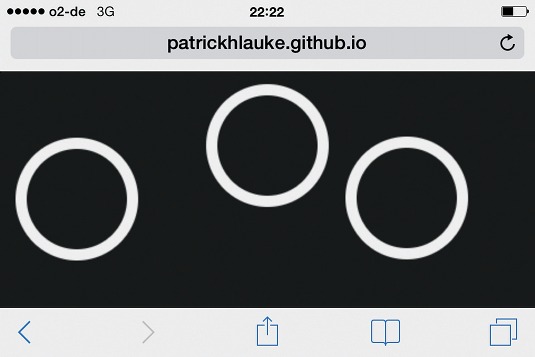
var posX, posY; office positionHandler(e) { if ((e.clientX)&&(e.clientY)) { posX = due east.clientX; posY = due east.clientY; } else if (e.targetTouches) { posX = e.targetTouches[0].clientX; posY = eastward.targetTouches[0].clientY; e.preventDefault(); } } canvas.addEventListener('mousemove', positionHandler, false ); canvas.addEventListener('touchstart', positionHandler, false ); canvas.addEventListener('touchmove', positionHandler, fake ); Testing the modified script (see example6.html in the tutorial files) on a touchscreen device, y'all'll meet that tracking a single finger movement at present works reliably. If we desire to expand our case to also work for multi-touch, nosotros'll need to change our original approach slightly. Instead of a single coordinate pair, we'll consider a whole array of coordinates, which we'll process in a loop. This will allow us to track single mouse pointers likewise as any multi-touch finger movements a user makes (see example7.html in the tutorial files):
var points = []; office positionHandler(e) { if ((e.clientX)&&(e.clientY)) { points[0] = e; } else if (e.targetTouches) { points = due east.targetTouches; e.preventDefault(); } } function loop() { ... for (var i = 0; i<points.length; i++) { /* Depict circle on points[0].clientX / points[0].clientY */ ... } } 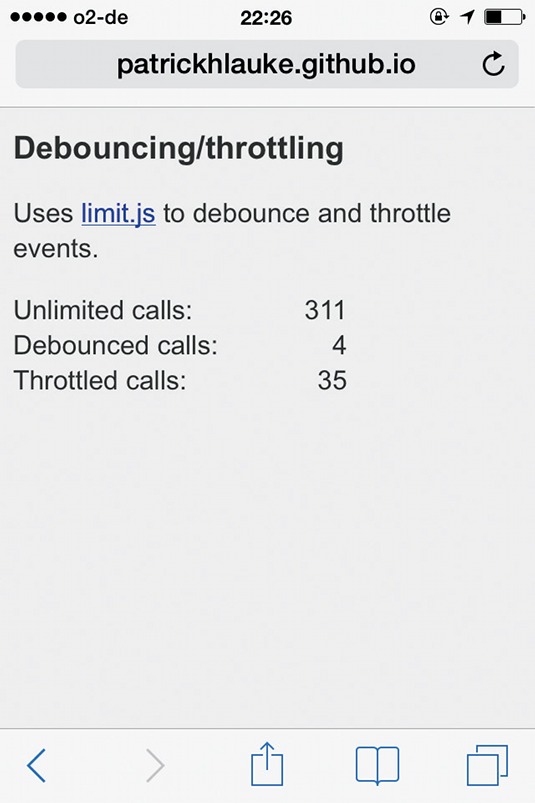
Operation considerations
As with mousemove events, touchmove can burn down at a high rate during whatever finger movements. It's advisable to avoid executing intensive code, such as complex calculations, or even entire cartoon operations, for each move event. This is important for older, less performant touch devices. In our instance, nosotros do the accented minimum past simply storing the latest array of mouse or touch point coordinates. The lawmaking to actually redraw our canvas is executed independently in a separate loop called via setInterval .
If the number of events that your script needs to procedure is still also loftier, it may be worth debouncing or throttling these events farther with solutions like limit.js.
Determination
Although, by default, browsers on touch-capable devices do a reasonable task of handling mouse-specific scripts, there are still situations where it may be necessary to further tweak our code specifically for affect interactions.
Throughout this project tutorial, nosotros've looked at the basics of how to handle touch events in JavaScript. Hopefully this tutorial has given y'all a solid introduction into why affect events are necessary, also as a foundation to build on for how they can be used to make your websites and applications work well on touch devices.
Words: Patrick H Lauke
This article originally appeared in cyberspace magazine result 248.
Related articles

Source: https://www.creativebloq.com/javascript/make-your-site-work-touch-devices-51411644
Posted by: mcvayroys1988.blogspot.com
0 Response to "how does one touch binary options work"
Post a Comment